(a) Prove that \(f(A \cap B) \subseteq f(A)\cap f(B)\).
(b) Prove that it's not necessarily the case that \(f(A)\cap f(B) \subseteq f(A \cap B)\) by giving specific finite sets and a specific function for which this inclusion does not hold.
Stuck? Here are some hints.
Here is the solution to (a) and the solution to (b).
Now let's define:
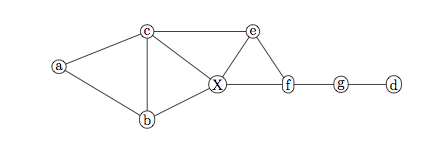
\( \begin{eqnarray*} M &=& \{1,2,3\} \\ f(k) &=& \{n \in V\ :\ d(n,X) = k\} \\ P &=& \{f(k) \mid k \in M \} \end{eqnarray*} \)
(a) Fill in the following values:
f(1) =
f(3) =
(b) Is P a partition of V? For each of the three conditions required to be a partition, explain why P does or doesn't satisfy that condition.
Stuck? Here are some hints.
Here are the solutions.
\(X \sim Y\) if and only if \(X \oplus Y\) is finite.
(a) First, figure out what the relation does:
(b) Warm-up problem for part (c): prove that \((A - C) \subseteq (A-B) \cup (B - C)\) for all sets A, B, and C.
(c) Prove that \(\sim\) is an equivalence relation.
(a) How many natural number solutions are there for the equation \(a+b+c=11\)?
(b) How many positive integer solutions are there for the equation \(a+b+c=11\)?